Life of Prophet Mohammad

Introduction
The life of Prophet Muhammad (peace be upon him), the last messenger of Islam, stands as one of the most documented and impactful biographies in world history. Born in 570 CE in the city of Mecca in the Arabian Peninsula, Prophet Muhammad’s life was marked by profound moral integrity, transformative social reform, and unwavering dedication to spiritual monotheism. His legacy is not confined to the boundaries of religion alone; rather, it extends into ethics, governance, international relations, gender justice, and humanitarian principles. This article aims to provide a comprehensive overview of the Prophet’s life, divided into key phases—his early life, prophethood, the Meccan and Medinan periods, and his lasting legacy.
- Early Life and Background
Prophet Muhammad (peace be upon him) was born into the tribe of Quraysh, a respected lineage in Mecca. His father, Abdullah, died before his birth, and his mother Amina passed away when he was just six years old. He was raised first by his grandfather Abdul Muttalib and later by his uncle Abu Talib. Despite the challenges of early orphanhood, Muhammad developed a character defined by trustworthiness, earning him the title “Al-Amin” (the trustworthy) among his people.
From a young age, he demonstrated a contemplative nature. He distanced himself from the idol-worshipping practices of his tribe and frequently sought solitude in the Cave of Hira, where he reflected on the state of humanity and the injustices of Meccan society.
His work as a merchant under the employ of a wealthy widow, Khadijah, brought him both reputation and stability. At the age of 25, he married Khadijah, who was 15 years his senior. Their marriage was a source of profound support and mutual respect, lasting 25 years and producing several children, including Fatima, the mother of the Prophet’s grandsons, Hasan and Husayn.
- Revelation and the Call to Prophethood
At the age of 40, during one of his meditative retreats in the Cave of Hira, Muhammad (peace be upon him) received his first revelation through the angel Jibreel (Gabriel). The command “Iqra” (Read/Recite) marked the beginning of his prophetic mission. Over the next 23 years, these revelations would be compiled into the Qur’an, the holy scripture of Islam.
Initially, he preached privately, calling close friends and family to the worship of one God (Tawheed), urging moral conduct, charity, and social justice. Among the earliest converts were his wife Khadijah, his cousin Ali, his freed slave Zayd ibn Harithah, and his close friend Abu Bakr. When he began to preach publicly, resistance from the Quraysh leadership intensified, who saw his message as a threat to their religious and economic power.
The Meccan period of his life (610–622 CE) was characterized by persecution, social ostracism, and boycotts. Despite these hardships, the Prophet remained patient and steadfast, emphasizing compassion and forgiveness. Perhaps the most poignant example was his reaction to the people of Ta’if who violently rejected his call—he prayed for their guidance rather than their destruction.
- The Hijrah: Migration to Medina
In 622 CE, due to escalating threats in Mecca, Prophet Muhammad and his followers migrated to Yathrib (later named Medina). This event, known as the Hijrah, marks the beginning of the Islamic calendar. Unlike Mecca, Medina welcomed him not merely as a religious leader but as a statesman and peacemaker.
In Medina, he established the first Islamic state based on principles of justice, consultation (Shura), and mutual protection. The Constitution of Medina, drafted under his leadership, stands as one of the earliest examples of a pluralistic social contract, granting equal rights and protection to Muslims, Jews, Christians, and pagans alike, provided they maintained peace and fulfilled mutual obligations.
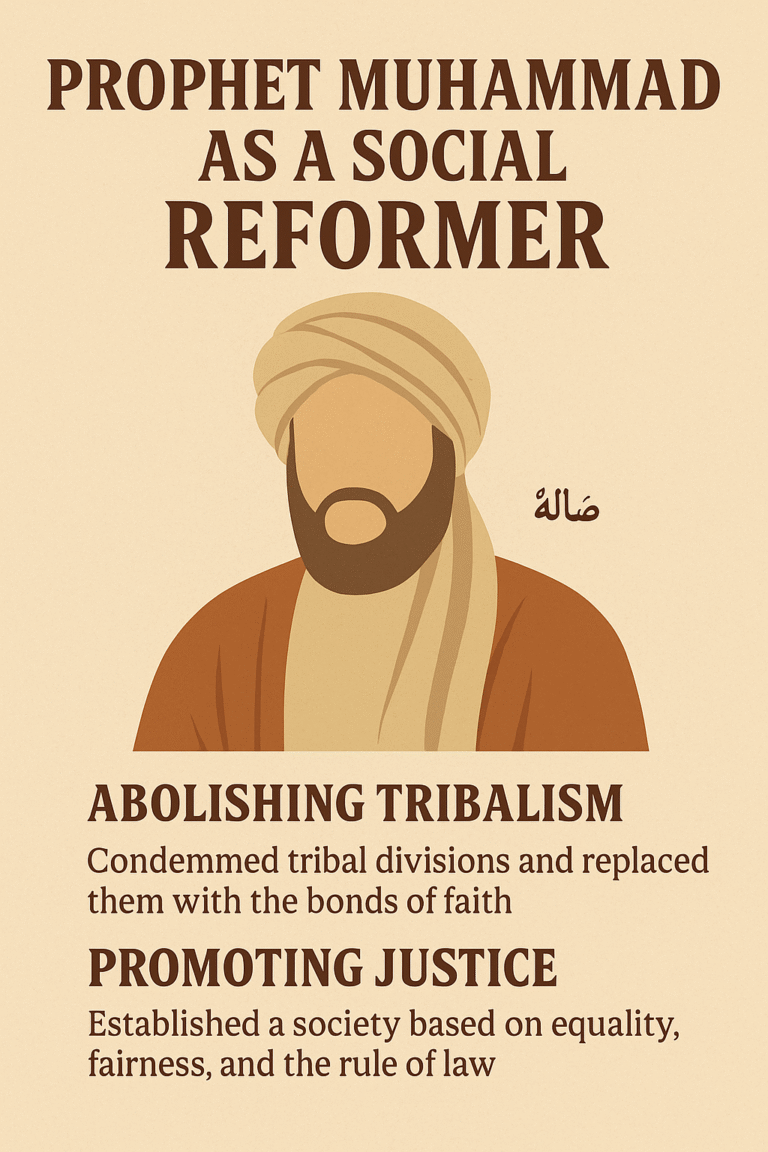
Prophet Muhammad’s leadership in Medina displayed his qualities as a legislator, judge, military commander, and diplomat. He organized the society through principles of accountability, charity (Zakat), equity in trade, women’s rights, and family law. He abolished practices such as female infanticide and placed spiritual reward in the treatment of the poor, orphans, and captives.
- Military Engagements and Ethics of War
The early Muslim community in Medina had to defend itself against repeated aggression from the Quraysh and other hostile tribes. Battles such as Badr (624 CE), Uhud (625 CE), and the Battle of the Trench (627 CE) are notable events. While these engagements had military dimensions, the Prophet’s rules of warfare included explicit instructions: do not harm civilians, do not cut trees or destroy crops, and do not attack places of worship.
He forgave numerous enemies, including those who had attempted to assassinate him. The Treaty of Hudaybiyyah (628 CE), signed between the Muslims and the Quraysh, was a significant act of diplomacy, demonstrating his preference for peace over conflict. Though the treaty was initially seen as unfavorable to the Muslims, it paved the way for the peaceful spread of Islam across the Arabian Peninsula.
- The Conquest of Mecca and the Triumph of Forgiveness
In 630 CE, Prophet Muhammad (peace be upon him) returned to Mecca with a ten-thousand-strong peaceful army. Contrary to the practices of revenge and bloodshed that were rampant in tribal Arabia, he entered the city with humility and declared general amnesty. Addressing the Quraysh, he asked:
“What do you think I will do to you?”
They replied, “You are a noble brother and the son of a noble brother.”
He said, “Go, for you are free.”
This act of mercy solidified his moral authority and led many Meccans to embrace Islam. He then cleansed the Kaaba of idols, re-establishing it as the monotheistic house of worship built by Abraham and Ishmael.
- Farewell Sermon and Death
In 632 CE, during his final pilgrimage, Prophet Muhammad delivered the Farewell Sermon, a profound statement of universal human rights, social justice, and the brotherhood of humanity. He emphasized the sanctity of life, property, and honor; condemned racism; upheld women’s rights; and reminded his followers of their accountability before God.
He declared:
“All mankind is from Adam and Eve. An Arab has no superiority over a non-Arab, nor a non-Arab over an Arab… except by piety and good action.”
Shortly after returning to Medina, he fell ill and passed away in the house of his wife Aisha on 12 Rabi al-Awwal, 11 AH (June 632 CE). He was buried in the chamber that today forms part of the Prophet’s Mosque in Medina.
- His Character and Ethics
The Prophet’s character was a living embodiment of the Qur’an. Aishah (may Allah be pleased with her) was once asked about his conduct and replied, “His character was the Qur’an.”
His lifestyle was marked by simplicity. Despite leading a growing empire, he mended his own clothes, shared his meals with the poor, and slept on a mat of palm fibers. His speech was truthful yet gentle. He never struck a servant, woman, or child and never sought revenge for personal grievances.
He forgave those who harmed him and prayed for their guidance. He visited the sick, stood for funerals regardless of the deceased’s faith, and played with children in the streets. His treatment of women was revolutionary for the time—he upheld their right to education, inheritance, and consent in marriage.
- Legacy and Relevance Today
The Prophet Muhammad’s (peace be upon him) life is not merely of historical interest—it is a template of human excellence, leadership, resilience, and divine connection. His life continues to influence over 1.9 billion Muslims globally, not just in matters of faith, but also in law, governance, education, and interpersonal ethics.
Contemporary scholars and thinkers across cultures have acknowledged his contributions. Mahatma Gandhi once remarked, “I wanted to know the best of the life of one who holds today an undisputed sway over the hearts of millions… I became more than convinced that it was not the sword that won a place for Islam in those days in the scheme of life. It was the rigid simplicity, the utter self-effacement of the Prophet…”
In an age of increasing polarization, violence, and moral uncertainty, the Prophet’s life offers a model of balance between spiritual depth and worldly responsibility, between individual rights and collective harmony.
Conclusion
Prophet Muhammad’s (peace be upon him) life was not a tale of mythical heroism but a testament to a man chosen to uplift humanity from ignorance, injustice, and spiritual loss. His mission was not to dominate but to liberate—to free minds from superstition, hearts from hatred, and societies from corruption.
To truly understand his life is to appreciate a model of how to live justly, love unconditionally, lead wisely, and serve selflessly. His legacy continues, not just in rituals or texts, but in the everyday ethical lives of millions who strive to follow his example as Rahmatan lil-Alamin—a mercy to all the worlds.
About the Author